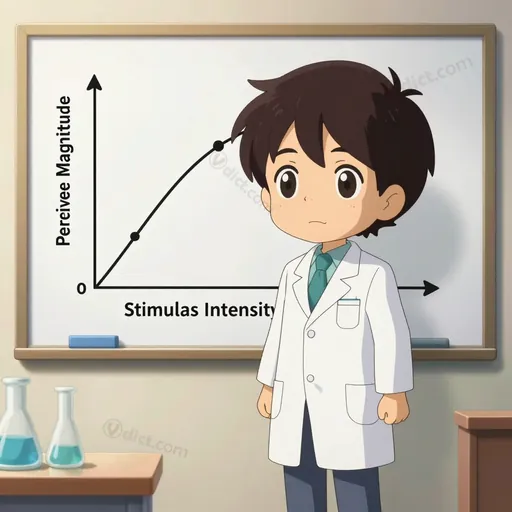
stevens' law
Definition
Noun (Psychophysics): The concept that the magnitude of a subjective sensation increases in proportion to a power of the stimulus intensity. It is a mathematical model describing the relationship between the physical magnitude of a stimulus and its perceived intensity.
Usage
This term is used specifically in the field of psychophysics, which studies the relationship between physical stimuli and the sensations and perceptions they produce. It is often cited in contrast to Weber's law or Fechner's law.
Examples
- In academic writing: "According to Stevens' law, the perceived brightness of a light grows as a power function of its physical intensity."
- In a textbook: "Stevens' law is expressed by the formula Ψ = kIⁿ, where Ψ is the perceived magnitude, I is the physical intensity, and k and n are constants."
- In discussion: "The experiment's results supported Stevens' law, showing a non-linear relationship between stimulus strength and sensation."
Advanced Usage
- Power Law: Stevens' law is frequently referred to as the power law of psychophysics. This highlights its mathematical form, where sensation is proportional to stimulus intensity raised to an exponent.
- Exponent (n): A critical component of the law is the exponent , which varies by sensory modality. For example, the exponent for electric shock is greater than 1 (supra-linear), while for brightness it is less than 1 (sub-linear).
Variants and Related Words
- Stevens' power law: A common full name for the concept.
- Psychophysical scaling: The general methodological field in which Stevens' law is a central model.
- Magnitude estimation: The primary experimental method developed by S. S. Stevens to measure sensation and validate his law.
Synonyms
- Power law (of sensation): A direct synonym emphasizing the mathematical relationship.
- Stevens' power law: The full, precise term.
Related Concepts (Not Synonyms)
- Fechner's law: Proposes a logarithmic relationship between stimulus and sensation.
- Weber's law: States that the just-noticeable difference between two stimuli is proportional to the magnitude of the original stimulus.
- Psychophysics: The broader scientific discipline.
Noun
-
(psychophysics) the concept that the magnitude of a subjective sensation increases proportional to a power of the stimulus intensity
Khám phá thêm
Các từ liên quan
Từ đồng nghĩa